
Markforged Onyx® 3D Printing: A Modern Solution for High‑Strength Complex Parts
- May 20
- 3 min read
Updated: Aug 28
The world of pattern making is changing fast, and at MJY Patterns, we’ve embraced a major leap forward. Alongside our traditional craftsmanship, we now use advanced 3D printing technology to produce smaller, highly intricate patterns with exceptional accuracy. Using Markforged Onyx®, a micro‑carbon‑fibre‑filled nylon composite, we’re able to create strong, dimensionally stable components that stand up to industrial foundry use.
This capability doesn’t just enhance our pattern work; it expands what we can offer. We can now print functional parts, whether you need a one-off component, a prototype, or a short production run of multiples. It’s a powerful blend of modern engineering and practical problem-solving, giving our customers more flexibility, faster turnaround times, and new possibilities for complex designs.
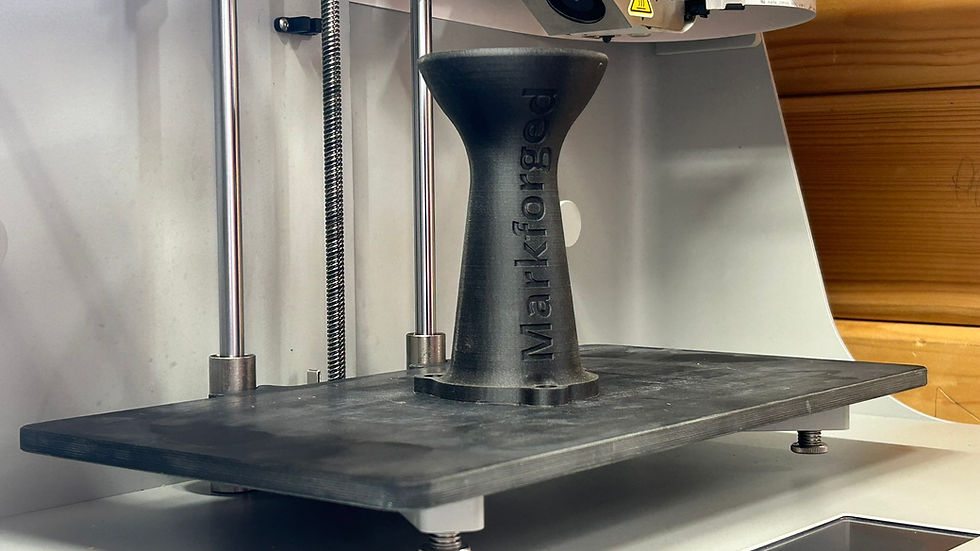
What Makes Markforged Onyx® Different?
Onyx® is a composite material made from micro carbon fibre filled with nylon. This combination offers several advantages over standard 3D printing filaments:
High strength and durability: The carbon fibre reinforcement gives parts exceptional mechanical properties; high strength, toughness, and chemical resistance.
Near flawless surface finish: The nylon base allows for smooth, consistent layers that reduce post-processing.
Precision in small, intricate patterns: The material supports fine details without compromising strength.
These qualities make Onyx® ideal for functional prototypes and end-use parts that require both accuracy and toughness.
Applying Onyx® to Complex Project Designs
In a recent project for a building services and utilities company, the challenge was to produce a pressure‑test bottom cap with tight tolerances and a complex shape. We were provided with a detailed 3D file alongside the CAD drawing, giving us an accurate foundation to print from. Before production, we also modified the 3D CAD data to account for material contraction and incorporate the correct mould tapers, ensuring the final printed component matched the required dimensions perfectly.

Using the Markforged 3D printer, we were able to:
Translate the CAD design into a physical part without losing detail.
Maintain dimensional accuracy critical for pressure testing applications.
Achieve a surface finish that minimised the need for additional machining or polishing.
This approach saved time and cost compared to traditional manufacturing methods such as CNC machining or injection molding, which would have required expensive tooling and longer lead times.
Practical Tips for Using Onyx® in Your Projects
If you are considering using Markforged Onyx® for your next project, keep these points in mind:
Prepare detailed CAD models: The accuracy of the final part depends on the quality of the digital design.
Understand material properties: Onyx® offers great strength but has specific temperature and environmental limits.
Plan for post-processing: While the surface finish is excellent, some applications may still require light sanding or sealing.
Test prototypes early: Use printed parts for functional testing to catch design issues before full production.
By following these steps, you can maximize the benefits of this advanced 3D printing technology.

Moving Forward with Precision Manufacturing
Modern 3D printing with Markforged Onyx® is transforming how projects are designed and executed. The ability to produce small, intricate, and strong parts directly from CAD files opens new possibilities for engineers and designers.
Conclusion
In conclusion, the integration of advanced 3D printing technology with traditional pattern making is a game changer. It allows for the production of high-precision components that meet the demands of modern industrial applications. The use of Onyx® not only enhances the quality of the patterns but also provides flexibility and efficiency in the manufacturing process.


Comments